Choose a small act of kindness that has a clear endpoint
Helping can be meaningful without becoming an unlimited obligation. A bounded act of kindness makes the offer clear to both people and leaves room for consent. The aim is useful connection, not earning a mood improvement, rescuing someone without permission or taking responsibility beyond your role.
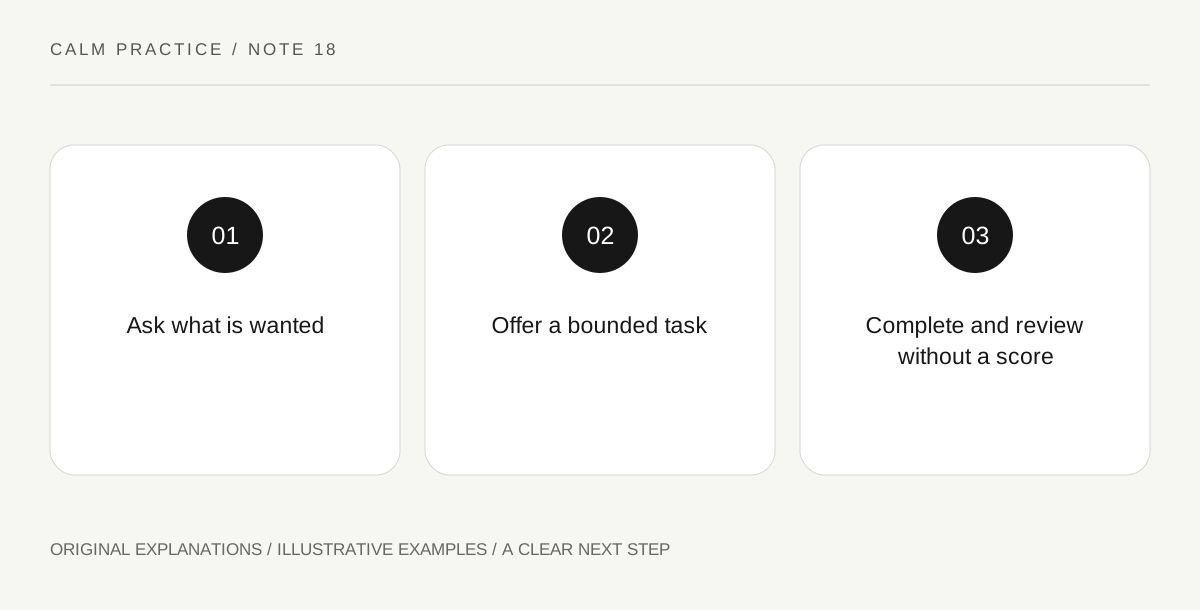
Original explanatory diagram. Read the full method and limitations below.
Ask what would actually be useful
A kind intention does not establish another person's need. Ask before sending food, visiting or taking over a task, particularly when privacy, allergies, health or cultural preferences matter. NHS wellbeing guidance includes giving and kindness among possible supportive activities. The application here is practical and modest: choose help the recipient wants. A compliment, a thank-you or listening may be more appropriate than a project. Avoid treating another person's difficulty as an opportunity to prove generosity. Their choice to decline should remain ordinary, without pressure to explain or reassure you.
Define the offer's scope
State the task, timing and limit in plain language. Offering to collect one grocery order differs from becoming responsible for all future shopping. Keep any necessary authorization clear, especially for appointments, money or personal records. Do not promise expertise you do not have or perform a medical, legal or care task outside your role. A bounded offer is easier to accept because the recipient does not have to guess what they are asking of you. It also protects the helper from an open-ended commitment made in a moment of emotion and regretted later.
Carry out the agreed help without adding a performance
Follow the person's instructions and ask when something changes. Do not photograph, post or retell private details as proof of the good deed without appropriate consent. A small task can be complete without a public narrative. If the help reveals a need beyond your capacity, say so and discuss an appropriate route rather than silently taking it on. Keep your own necessary responsibilities covered. Kindness does not require ignoring exhaustion or becoming the sole support person. A clear endpoint can preserve both the usefulness of the task and the relationship around it.
If money is involved, agree the practical arrangement before the task. A helper collecting an order should know how payment and receipts will be handled, without taking on access to accounts unnecessarily. Clear details protect both people and make the offer easier to accept. The same principle applies to keys, addresses and private documents: use only the access needed for the agreed help and return it afterward.
Let the result belong to the situation
The recipient may feel grateful, distracted or still distressed. Your mood may or may not improve. Do not treat either response as a score for whether the act counted. Review whether the help was wanted, delivered as agreed and manageable. If you want to offer again, make a new clear agreement rather than assuming the original offer continues indefinitely. A small act can support connection without solving the entire problem. When the person's needs are serious or ongoing, encourage appropriate professional or community support rather than positioning your own kindness as a replacement.
An illustrative bounded offer
Oli asks a neighbor whether collecting one agreed grocery order would help. They confirm the items, payment arrangement and delivery time. Oli completes the task privately and does not assume responsibility for future shopping. The act has a clear endpoint even though the neighbor's broader difficulty remains.
Practical checks
Optional checkboxes save only in this browser.
Questions that come up
Is a small act less meaningful than a large one?
Not necessarily. Useful, wanted help can be modest and fit both people's circumstances.
Must helping make me feel better?
No. It is not a guaranteed mood intervention. Judge whether the act was appropriate and useful, not whether it produced a particular feeling.
References and scope
These sources support the factual background. Examples and exercises are original illustrative teaching material. References do not imply endorsement.
- NHS: Five Steps to Mental Wellbeing — Connection, learning, kindness and present-moment attention.
- WHO: Doing What Matters in Times of Stress — Values, unhooking from difficult thoughts, making room for feelings and kindness.