Try one wellbeing practice as a small experiment rather than a new identity
A new practice can become demanding when it arrives with equipment, a streak and a promise to transform you. A small experiment asks a narrower question: does this activity fit my day and feel worth repeating? It leaves room to change your mind without treating a stopped routine as failure.
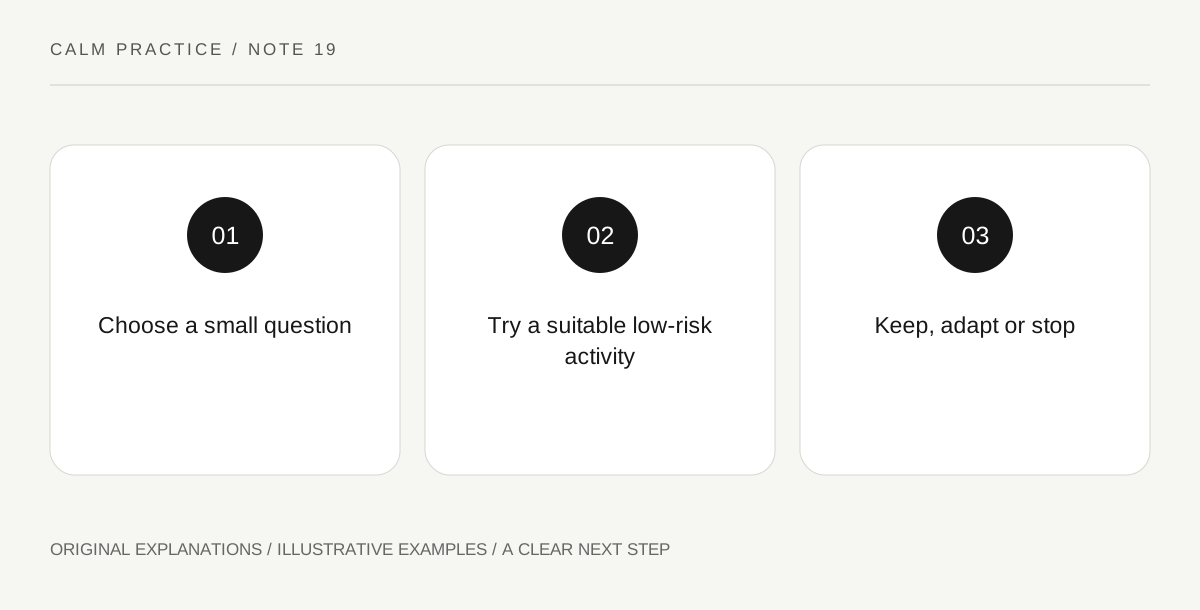
Original explanatory diagram. Read the full method and limitations below.
Choose a question you can actually answer
Ask about a practical experience, such as whether a short reading pause is welcome after lunch or whether a particular recording has clear instructions. Do not ask whether one week will cure stress or prove a new identity. NIMH describes self-care as varied activities that support wellbeing, while individual preferences differ. Keep the experiment low risk and compatible with health advice. A technique involving intense breathwork, extreme temperatures or stopping treatment is not the kind of everyday trial described here. Choose one familiar or clearly instructed option with a simple stop point.
Keep the setup smaller than the activity
Use what is already available when appropriate. A notebook, comfortable seat or existing book may be enough. Avoid buying a subscription or equipment bundle before you know what problem it solves. Set a scope that fits the actual day, with responsibilities and access needs accounted for. An illustrative duration is a planning choice, not a therapeutic dose. The trial should not depend on waking much earlier, completing many preparatory tasks or making every household member follow it. If the setup is cumbersome, that is useful information about fit rather than proof that you lack motivation.
Observe a few useful features
Notice whether the instructions were understandable, the timing feasible and the experience welcome. You do not need to collect a dense set of mood scores or compare wearable data before and after. A consumer device's changing number cannot establish that a practice treated a condition. Keep any note brief and private. If the activity causes discomfort or distress, stop rather than continuing to complete the experiment. A useful trial includes the possibility that the method is unsuitable. You can learn that without replacing it immediately with another wellness task or blaming yourself for having the wrong response.
Decide whether to keep, adapt or stop
After enough ordinary attempts to understand the practical arrangement, make a modest decision. Keep the helpful part, change one barrier or stop. NHS guidance on staying well supports reviewing useful strategies, but this article does not prescribe a universal trial length. Do not turn the review into another compulsory routine. Professional support remains appropriate when symptoms persist or daily functioning is affected, regardless of how many practices you have tried. The useful outcome is a better fit between an activity and your life, not a perfect streak or proof that you have become a calm person.
Separate the activity from the tracking feature. A reading pause may be welcome while an app's streak creates pressure. You can keep the book and stop the streak. Similarly, a useful recording may not need a new journal entry after every use. Review each added requirement on its own. The experiment should teach you what serves the activity rather than making the measurement system the most demanding part of the routine.
An illustrative reading trial
Pia wants a screen-free pause and tries reading a familiar book after lunch on a few suitable days. She notices that the location is noisy and the book is welcome, so she changes the place rather than buying a wellness course. She keeps the activity only if it remains practical and enjoyable.
Practical checks
Optional checkboxes save only in this browser.
Questions that come up
Must I track a daily mood score?
No. Use only information that helps the decision. A brief practical note may be sufficient.
Does stopping mean the trial failed?
No. Learning that an activity does not fit is a useful result. Seek care when distress needs more than an everyday experiment.
References and scope
These sources support the factual background. Examples and exercises are original illustrative teaching material. References do not imply endorsement.
- NIMH: Caring for Your Mental Health — Self-care, regular nourishment, enjoyable activities and professional support.
- NHS: Staying on Top of Things — Reviewing useful wellbeing strategies and planning for difficult periods.