Put a pause between an angry draft and the message you actually send
A frustrating message can create an urge to respond before you know what you want the reply to achieve. A pause gives the communication a second decision point. It does not require denying anger, tolerating abuse or delaying a genuine emergency; it helps keep an ordinary response connected to a clear purpose.
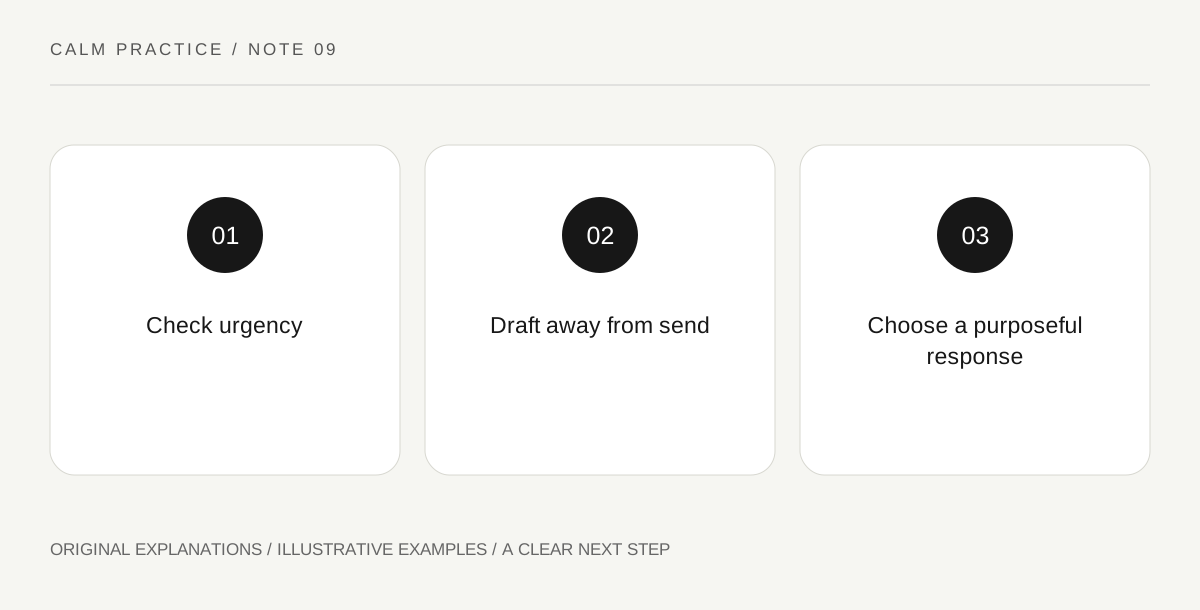
Original explanatory diagram. Read the full method and limitations below.
Check urgency before choosing a pause
Ask whether immediate action is actually required for safety, care or a real deadline. If so, use the appropriate route. Otherwise, separate the urge to reply from the need to reply now. NHS anger guidance recommends giving yourself time before reacting. The application here is a nonurgent written exchange, not a rule for every conflict. Do not use a pause to ignore threats or remain in an unsafe situation. If the message concerns abuse, harassment or another serious issue, preserve relevant evidence and seek appropriate support rather than treating it only as an emotional regulation exercise.
Keep the draft somewhere it cannot be sent accidentally
Use a separate document or another appropriate method rather than a reply box with the recipient already filled in. Follow workplace and privacy requirements for sensitive information. Write what you need to understand privately, but avoid forwarding confidential material to a personal account. The point is creating a real separation between expression and transmission. A scheduled-send feature may be useful in some settings, but it is not a substitute for checking the message and knowing how the feature works. Do not assume every platform provides an undo window or that deleting a sent message removes recipient copies.
Read the final message once for assumptions about motives. A sentence explaining what happened and what you need can be firm without claiming to know why the other person acted. If motive is central, ask rather than state it as fact. Keep the response appropriate to the relationship and setting. A factual record may be especially important in a formal process, where an emotional draft and an accurate account serve different purposes.
Name the reply's actual purpose
Decide whether you need information, a correction, a boundary or a practical agreement. Remove material that does not serve that purpose, such as guessing motives or collecting every previous grievance. A firm response can remain clear and proportionate. You do not have to make it warm or cheerful. Ask whether the message states the relevant fact, request and next step. If the issue needs a conversation or formal process, choose that route rather than trying to resolve everything in one long text. Another trusted person can review wording when appropriate, with confidentiality respected.
Review, send or choose another route
Return after a suitable pause and reread as the recipient will see it. Check names, facts, attachments and tone alongside the substantive request. Decide whether sending still serves the purpose. A pause is not a promise that you will feel no anger; it creates an opportunity to choose. If anger repeatedly leads to harmful behavior or feels unmanageable, seek qualified support. The useful outcome is a message or action you can explain in terms of its purpose, not a victory over the other person or proof that you never react emotionally.
An illustrative delayed reply
After a nonurgent scheduling dispute, Sana drafts her reaction in a separate work-approved note. Later she identifies the actual need: a confirmed deadline. She sends a concise request with the relevant facts rather than the full angry draft. The pause changes the communication without requiring her to approve the situation.
Practical checks
Optional checkboxes save only in this browser.
Questions that come up
Does a pause mean I must become friendly?
No. A response can be firm and respectful while maintaining a boundary or using a formal process.
Should threats be handled as an ordinary drafting exercise?
No. Prioritize safety, preserve relevant evidence and seek appropriate help for threats, abuse or harassment.
References and scope
These sources support the factual background. Examples and exercises are original illustrative teaching material. References do not imply endorsement.
- NHS: Anger — Taking time before reacting and seeking help for persistent or harmful anger.