After an ordinary disagreement, make a repair without replaying it all evening
A difficult exchange can continue internally long after the practical conversation ends. A useful repair names your part, addresses a concrete impact and leaves room for the other person's response. It does not require repeated apologies until you feel reassured, or accepting responsibility for everything that happened.
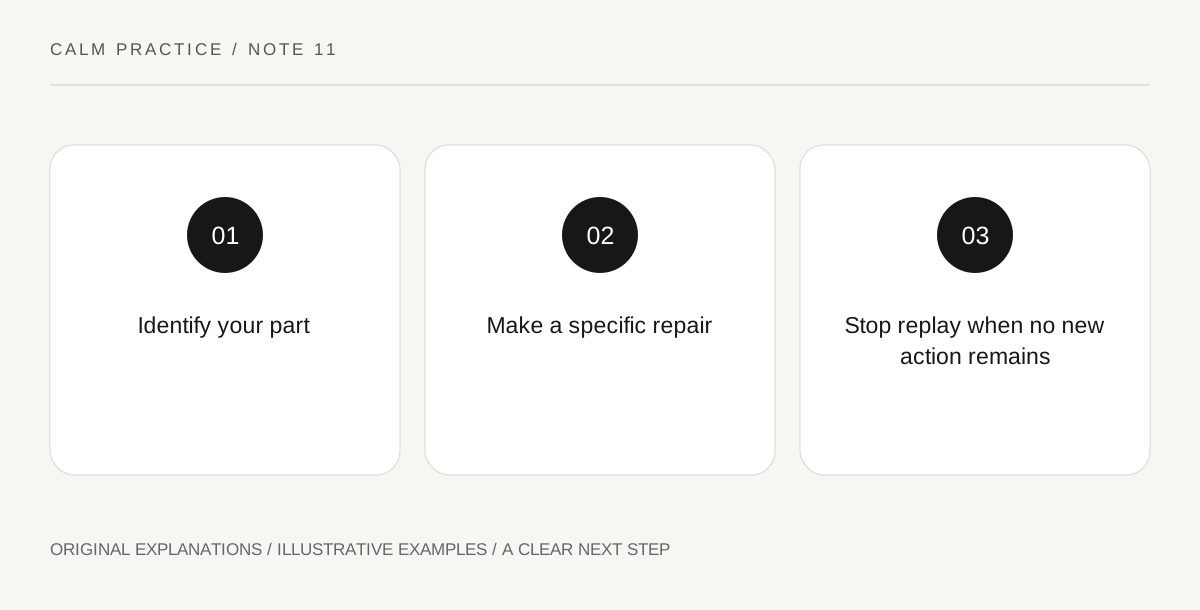
Original explanatory diagram. Read the full method and limitations below.
Separate your action from the whole disagreement
Describe the behavior you want to address, such as interrupting or speaking harshly. Keep it distinct from the substantive issue, which may still need discussion. You can regret the way you spoke without withdrawing a reasonable boundary. NHS anger guidance encourages time to think and seeking help when reactions become harmful or unmanageable. This article concerns an ordinary safe disagreement, not abuse or a situation requiring protection. Do not use a repair script to excuse threats or pressure someone to resume contact. The other person may need space, and safety takes priority over completing a preferred conversation.
Make one specific acknowledgement
A concise acknowledgement can name what you did and the impact you understand. Avoid adding a long defense immediately after the apology or making the other person responsible for soothing your guilt. If you are uncertain about their experience, ask without demanding an answer. A statement such as I interrupted and want to hear the rest is more actionable than a global claim that you are terrible. Keep the wording honest. Do not promise a permanent personality transformation to end the discomfort. A useful repair can include a realistic change in how the next conversation will be handled.
Choose a practical next step if one is needed
The next step might be listening, correcting a message, replacing something damaged or agreeing a better discussion time. It should fit the actual impact and any relevant process. If the disagreement concerns work or another formal setting, follow appropriate organizational routes. Avoid making an unrelated grand gesture to erase the event. A repair is not a purchase of forgiveness. The other person can respond differently from what you hope, and a meaningful apology does not create an obligation for immediate reassurance. Keep the underlying issue available for a separate clear discussion where appropriate.
Notice when replay no longer adds information
After an appropriate repair, ask whether another mental replay reveals a new action or repeats the same self-judgment. You may still feel embarrassed or unsettled. Choose a suitable ordinary activity without requiring the feeling to disappear first. If the pattern is frequent, distressing or linked to harmful behavior, seek qualified support. A balanced reflection can identify a lesson without turning the entire evening into a trial of your character. The useful endpoint is responsibility with a next step, not certainty that everyone approves of you or a repeated apology that shifts attention away from the person affected.
Keep a lesson specific enough to use. Remember to let someone finish is more useful than never upset anyone again. The latter is impossible and can create another cycle of self-monitoring. A small behavior change can be reviewed in the next relevant conversation without reopening the old disagreement each evening. If the pattern involves repeated harm, a broader support process is needed rather than increasingly polished apologies.
An illustrative repair
After interrupting a friend, Mae acknowledges the interruption and invites the friend to finish. She listens without turning the apology into a demand for reassurance. Later she notices repeated internal replay but no new action to take, so she returns to an ordinary evening task while keeping the lesson for the next conversation.
Practical checks
Optional checkboxes save only in this browser.
Questions that come up
Does apologizing mean my original concern was wrong?
Not necessarily. You can address how you behaved while retaining a reasonable concern or boundary.
Must the other person forgive me immediately?
No. A repair does not control their response. Respect space, safety and any appropriate next process.
References and scope
These sources support the factual background. Examples and exercises are original illustrative teaching material. References do not imply endorsement.
- NHS: Anger — Taking time before reacting and seeking help for persistent or harmful anger.
- NHS: Reframing Unhelpful Thoughts — Examining thoughts and considering balanced alternatives.