Agree how a difficult conversation pauses and resumes
A pause can help an ordinary disagreement become more manageable when both people know what it means. Without that agreement, leaving the room may feel like abandonment or a way to avoid the issue. A useful pause includes safety, a clear return plan and freedom from pressure, rather than a demand that everyone calm down on command.
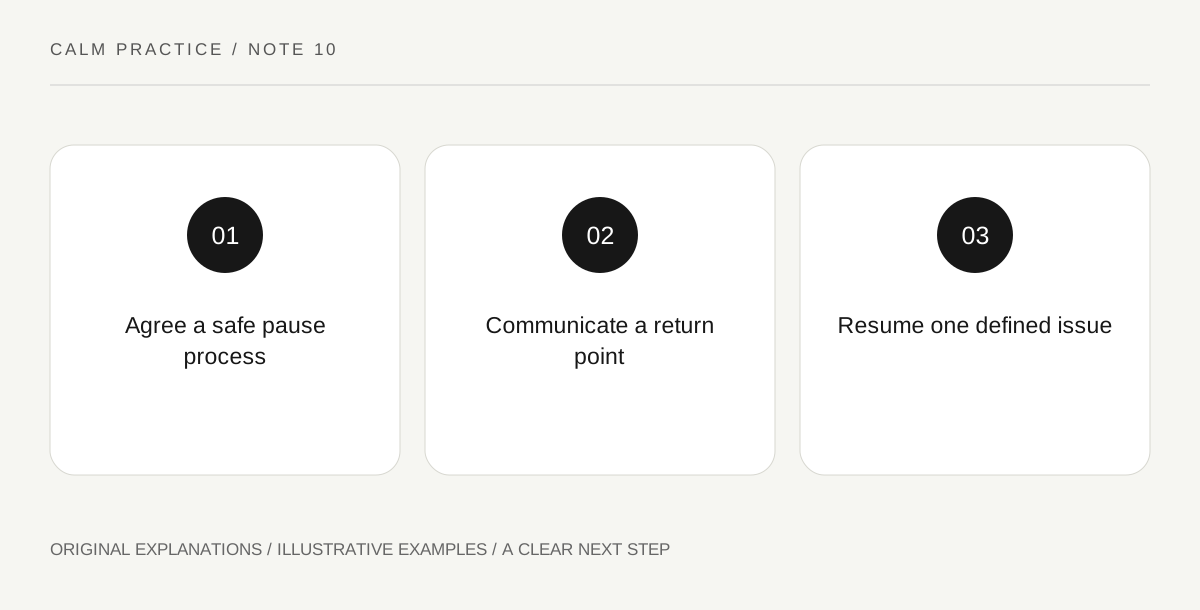
Original explanatory diagram. Read the full method and limitations below.
Keep safety separate from conversation technique
This framework is for an ordinary disagreement between people who can communicate safely. It is not advice to negotiate with someone who is threatening, coercive or violent. In an unsafe situation, seek appropriate help and prioritize protection. For a safe disagreement, choose a time outside the argument to discuss how a pause could work. NHS anger advice supports taking time before reacting. The application here adds a shared practical agreement. Neither person should have to prove distress or obtain permission to stop an escalating exchange, and a pause should not be used to trap someone in the conversation.
Use a clear phrase and practical meaning
Agree on wording such as I need a pause and want to return to this. Discuss what each person will do next and which responsibilities still need coverage. Avoid vague statements that sound like a permanent end to the relationship when the intention is a temporary break. Keep the agreement realistic for the setting. A conversation at home, a work meeting and a discussion involving childcare have different logistics. The phrase is not a magic signal; its value comes from shared understanding and behavior. If the other person does not agree to the framework, do not assume a private rule binds them.
Set a return point without forcing readiness
Choose an appropriate time or route to check whether the conversation can resume. This is a practical agreement, not a clinically established cooling-off duration. If more time is needed, communicate that rather than disappearing indefinitely. Keep any urgent decision on its own appropriate timeline. During the pause, avoid sending a stream of messages that continues the argument by another channel. Choose a suitable ordinary activity and preserve safety and care duties. The goal is reducing escalation and returning with a clearer purpose, not building a case, rehearsing accusations or making the other person anxious about when you will return.
Agree on what happens if the proposed return time becomes impractical. A short update can prevent a temporary pause from turning into unexplained disappearance. The update should not restart the whole argument by text. It can simply propose another suitable time or a different process. This detail matters when work, care or travel interrupts the plan, and it keeps the pause connected to a real route back to the unresolved issue.
Resume around one defined issue
When both can continue safely, identify the specific question or decision rather than reopening every grievance. State what you understood and what remains unresolved. Acknowledge any harmful behavior without using the pause as an excuse. If the pattern repeats or the conversation cannot be managed, seek appropriate professional or organizational support. A shared pause is a communication tool, not treatment for relationship problems or a guarantee of agreement. Its success can be modest: the issue is discussed more clearly, or a suitable next process is chosen, even when the people still disagree.
An illustrative household agreement
Two housemates agree in advance that either may pause a nonurgent disagreement and propose a time to revisit it. During a dispute about shared chores, one uses that phrase and they return later to one specific task arrangement. Neither sends repeated argumentative messages during the break or treats the pause as a punishment.
Practical checks
Optional checkboxes save only in this browser.
Questions that come up
Does a pause guarantee agreement?
No. It can create a clearer process while disagreement remains. Another form of support or decision-making may still be needed.
Should I use this to manage a threatening person?
No. Prioritize safety and appropriate support rather than relying on a conversation technique in an unsafe situation.
References and scope
These sources support the factual background. Examples and exercises are original illustrative teaching material. References do not imply endorsement.
- NHS: Anger — Taking time before reacting and seeking help for persistent or harmful anger.
- NHS: Five Steps to Mental Wellbeing — Connection, learning, kindness and present-moment attention.