Plan an ordinary waiting period without rehearsing every possible appointment outcome
Waiting for an appointment can leave a gap that fills with repeated predictions. A practical waiting plan separates preparation from speculation and makes the setting easier to use. It does not promise a particular outcome or treat worry as a failure; it gives the next hour a clearer shape.
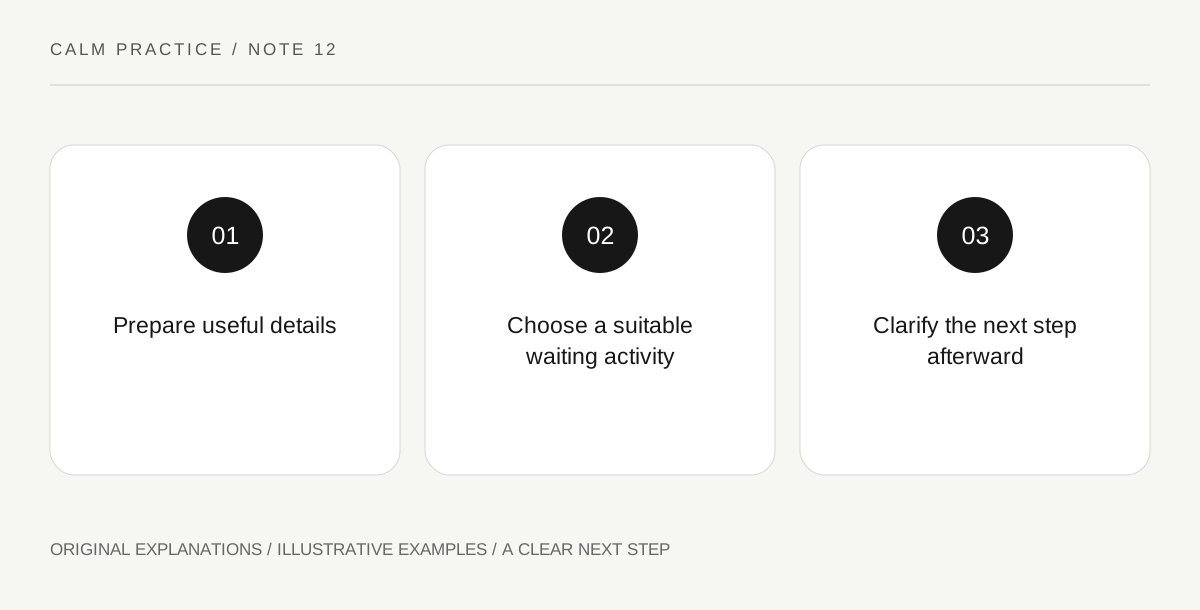
Original explanatory diagram. Read the full method and limitations below.
Finish the preparation that can actually help
Confirm the time, location, access arrangements and requested documents through the appropriate service. Write a short list of questions if that is relevant. Keep practical preparation separate from researching every possible outcome. NHS uncertainty guidance encourages focusing on useful actions. Once the necessary details are ready, repeated checking may add no information. If instructions are unclear, contact the service rather than guessing. This framework is for ordinary waiting, not urgent symptoms or a situation in which a clinician has advised immediate action. Follow the relevant care instructions and emergency route when needed.
Prepare a way to capture the next instruction that fits your needs. A written note, an accessible document or an agreed supporter can help, while recording audio requires permission and relevant service rules. Do not rely on remembering everything while worried. Ask for clarification before leaving when possible. This practical arrangement supports understanding and does not require the appointment to produce a particular reassuring answer.
Choose the waiting activity before you arrive
Pick something manageable that does not require constant concentration, such as familiar reading, a simple puzzle or a quiet conversation. Keep the choice small enough to stop when called. You do not need to turn waiting into productive work or a perfect relaxation session. Account for hearing announcements, access needs and any responsibility for another person. Headphones may be unsuitable if they block the information you need. A familiar activity can be easier than searching through a feed that repeatedly returns to frightening stories. The useful criterion is whether the activity fits the setting and your preferences.
Keep predictions in the uncertainty category
A thought about what might happen is not a result from the appointment. Notice the difference without arguing with every possibility. You can save one relevant question for the professional and leave the rest unresolved for now. Avoid seeking a guarantee from companions who do not have the information. They can offer company or practical help without predicting the outcome. If you want support, state the task clearly: sit with me, help note the next step or remind me of my question. This keeps the support useful without requiring another person to produce certainty.
Leave with the next step rather than a perfect memory
After the appointment, clarify instructions, timing and contact routes through the appropriate professional. Write down the part you need to act on. If you are still unsettled, that does not mean the waiting plan failed. Review whether logistics and support were usable. Seek qualified help when worry is persistent or disrupts daily life. An everyday waiting plan can reduce unnecessary decision-making while uncertainty remains. It is not a treatment or a substitute for understanding actual clinical advice. Its value lies in a clearer practical path before, during and after the visit.
An illustrative waiting-room plan
Jules confirms an appointment, prepares two questions and chooses a familiar book that can be put down easily. A companion agrees to help record the next step rather than promise a reassuring result. Jules still feels worried, but the waiting activity and support role are clear.
Practical checks
Optional checkboxes save only in this browser.
Questions that come up
Should I research until I feel certain?
A search may not provide certainty about a personal outcome. Use reliable information for a specific question and discuss it with the relevant professional.
Does continued worry mean the plan failed?
No. Judge whether the arrangement was practical, and seek support if worry is persistent or impairing.
References and scope
These sources support the factual background. Examples and exercises are original illustrative teaching material. References do not imply endorsement.
- NHS: Dealing with Change and Uncertainty — Managing uncertainty and focusing on useful present actions.
- NIMH: Caring for Your Mental Health — Self-care, regular nourishment, enjoyable activities and professional support.