Guided imagery is not a test of how vividly you can picture a place
A relaxation script may invite a beach or forest image that feels pleasant to one person and unwelcome to another. Guided imagery is optional, and vivid mental pictures are not an achievement requirement. A useful choice respects your own associations, the source's limits and the option to stop.
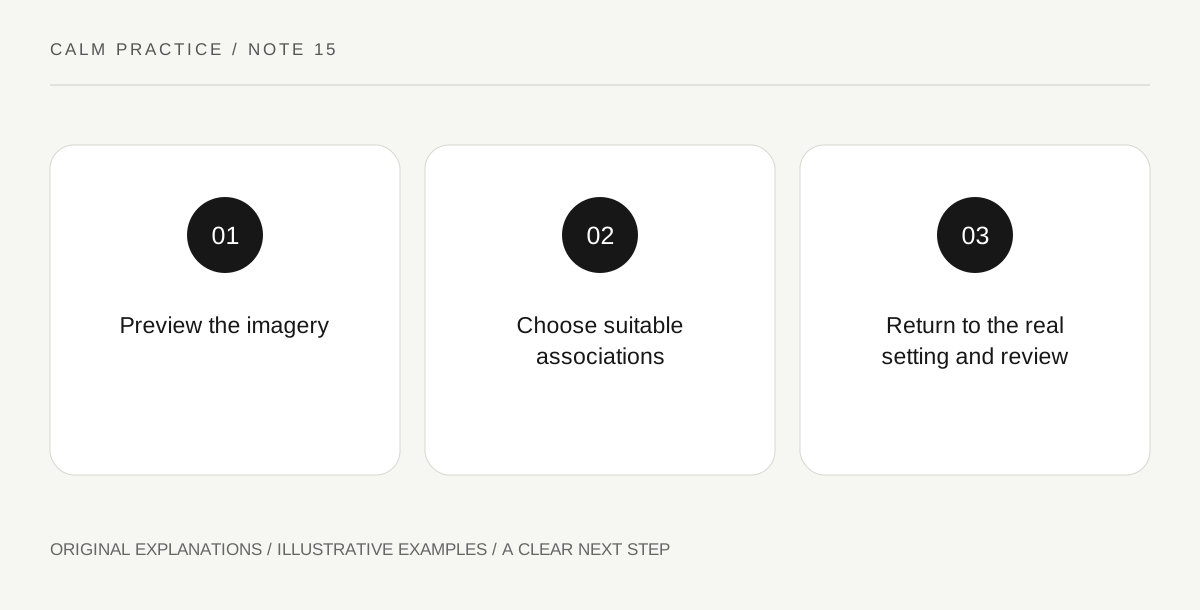
Original explanatory diagram. Read the full method and limitations below.
Check the script's content and purpose
Preview the source or read a transcript when available. Cambridge University Hospitals describes guided imagery as imagining a place associated with comfort and relaxation. That does not mean every standard scene will feel safe or suitable for every listener. A beach may connect with an unpleasant memory, and a crowded garden may be distracting. Choose a safe resting setting and avoid using a recording during driving or another task needing attention. Keep the practice separate from treatment claims. A calm voice and attractive production do not establish that a recording is suitable for trauma, pain or another condition.
Choose associations rather than obeying scenery
If the method allows adaptation, use a familiar neutral or pleasant setting rather than forcing the script's scene. It can be an ordinary room, a quiet corner or another place that feels comfortable to you. Do not deliberately revisit a difficult memory to prove you can transform it. If imagery feels uncomfortable, stop and choose another activity. The word safe in a recording is not a guarantee about your response. You do not owe the exercise a particular emotional reaction. An appropriate clinician can advise when a health or mental-health history makes the choice uncertain.
Let the experience be less visual if needed
Some people do not form vivid mental images. You may notice words, a general sense of a place or nothing especially detailed. Do not strain to create a cinematic picture or compare your experience with another person's description. Follow only cues that are comfortable and appropriate. Keep breathing ordinary rather than adding an unrequested breath-holding technique. The practice is not a concentration exam. If the effort to imagine becomes frustrating, a familiar external activity such as quiet reading may fit better. Choosing a different approach is information about preference, not proof that you cannot relax.
Return gently to the actual setting
Use the recording's suitable closing instructions or stop in an ordinary way, reorienting to where you are before standing or resuming tasks. Allow time to notice the room and any practical responsibility waiting. Do not treat a pleasant scene as a reason to ignore an unsafe environment or ongoing distress. Review whether the method was welcome and manageable. If it triggers distress, persistent detachment or another concerning experience, seek appropriate support. The useful outcome can be a brief enjoyable pause, but no particular result is guaranteed. Keep the option flexible rather than making imagery the only acceptable way to rest.
A personally meaningful place can also be complicated. A location associated with comfort may carry a difficult memory on another day. You are allowed to change the image, choose a neutral setting or stop. That variability does not require an explanation or a claim that the method has stopped working permanently. Keep the choice responsive to the present experience rather than treating one successful session as a contract to repeat it.
An illustrative scene choice
A recording describes an ocean scene, but that association is uncomfortable for Dana. She stops instead of forcing the picture. Later she considers a suitable source allowing a neutral familiar room, while keeping an ordinary reading option available. She does not judge the practice by how vividly she can see the imagined furniture.
Practical checks
Optional checkboxes save only in this browser.
Questions that come up
Must the image be vivid to count?
No. Vividness is not an achievement requirement. Choose a practice that feels suitable rather than forcing mental pictures.
Should I continue through distress to make it work?
No. Stop and seek appropriate guidance if needed. An optional relaxation method does not need to be endured.
References and scope
These sources support the factual background. Examples and exercises are original illustrative teaching material. References do not imply endorsement.
- Cambridge University Hospitals: A Brief Guide to Guided Imagery — Imagery as an optional relaxation approach and comfort with the chosen scene.
- NCCIH: Relaxation Techniques — Relaxation approaches, evidence limitations and safety considerations.