Choose a muscle-relaxation approach that does not require forcing tension
Some relaxation recordings ask you to tense and release muscles, while others use gentler attention or imagery. The methods are not interchangeable for everyone. Choosing a comfortable suitable approach matters more than completing every cue, especially when pain, injury or a health condition affects what you can do.
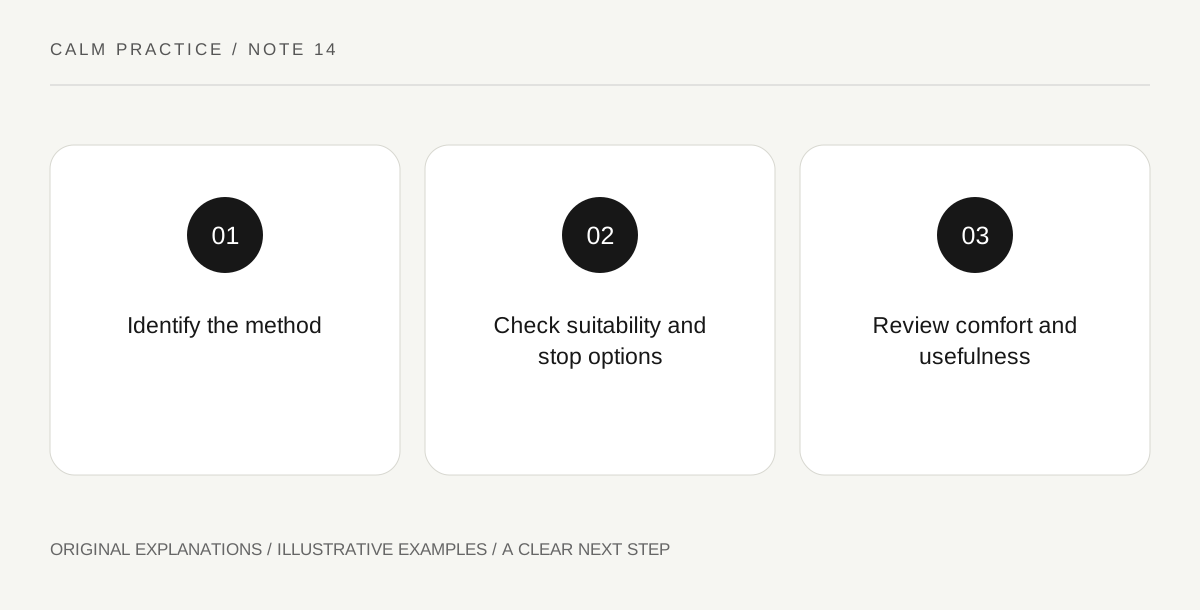
Original explanatory diagram. Read the full method and limitations below.
Identify the method before pressing play
Read the description or preview the recording. NCCIH distinguishes relaxation techniques such as progressive relaxation and guided imagery and notes that evidence and safety vary. A title containing calm does not explain whether the session uses muscle tension, breath control or an emotionally evocative scene. Check the source, intended audience and whether instructions are clear. Do not begin during driving, equipment operation or a duty requiring continuous attention. The aim is an optional practice in a safe resting setting. A recording designed for a clinical condition may not be a general instruction for every listener.
Keep physical limits visible
If you have pain, a recent injury or a condition affecting movement, ask an appropriate professional whether the method is suitable. Do not tense an area harder to make a contrast more noticeable, and do not treat pain as a normal price of relaxation. Follow the source's cautions and stop if the practice causes discomfort or distress. A gentle alternative may be preferable, but it should not be improvised as treatment. The practical choice can also be no recording at all. A person does not need to complete a whole-body sequence to deserve rest or to prove that they tried properly.
Make skipping and stopping part of the plan
Before starting, decide how to pause the audio and what ordinary activity you can return to. Keep the device within reach without creating a cable hazard. If a cue is unsuitable, stop or skip it according to appropriate guidance rather than pushing through to preserve a streak. You may keep eyes open if that is more comfortable and the method allows it. A relaxed sensation is not guaranteed, and some people find internal body attention unwelcome. Notice the experience without grading it. The method should serve you, not become another instruction set that must be completed perfectly.
If a session uses background music or spoken cues, keep the volume comfortable and preserve necessary awareness. Do not turn it up to overpower an unsuitable noisy setting. A different time, quieter place or non-audio option may fit better. The production quality of a recording is less important than whether you can understand and use its instructions without adding another source of strain or a need to block essential communication.
Review usefulness without a medical claim
Afterward, ask whether the instructions were understandable, the setting practical and the experience welcome. You do not need to measure blood pressure, heart rate or muscle softness to decide whether to use an optional recording again. Do not infer a health effect from a consumer device's changing score. If symptoms or distress persist, seek qualified care rather than increasing the practice indefinitely. Relaxation can coexist with treatment but should not replace it. A useful choice is a method you can approach comfortably within relevant advice, with permission to change or stop when it does not fit.
An illustrative recording choice
A recording asks Rowan to tense an area affected by a recent injury. Rowan stops and asks an appropriate clinician about suitable options rather than following the cue more gently on guesswork. For the moment, a familiar quiet activity provides a rest period without turning the recording into a required task.
Practical checks
Optional checkboxes save only in this browser.
Questions that come up
Must I tense every muscle group?
No. Do not force unsuitable cues. Follow appropriate guidance and stop for discomfort or distress.
Does a relaxation recording replace care for pain?
No. Persistent or concerning pain needs appropriate professional assessment and care.
References and scope
These sources support the factual background. Examples and exercises are original illustrative teaching material. References do not imply endorsement.
- NCCIH: Relaxation Techniques — Relaxation approaches, evidence limitations and safety considerations.