Choose the next useful update when uncertainty keeps reopening the same page
Waiting for information can turn a useful check into repeated refreshing that supplies no new answer. A practical update plan distinguishes an official change from the urge to feel certain. It preserves urgent communication while giving the waiting period a workable structure, without promising that you will stop feeling concerned.
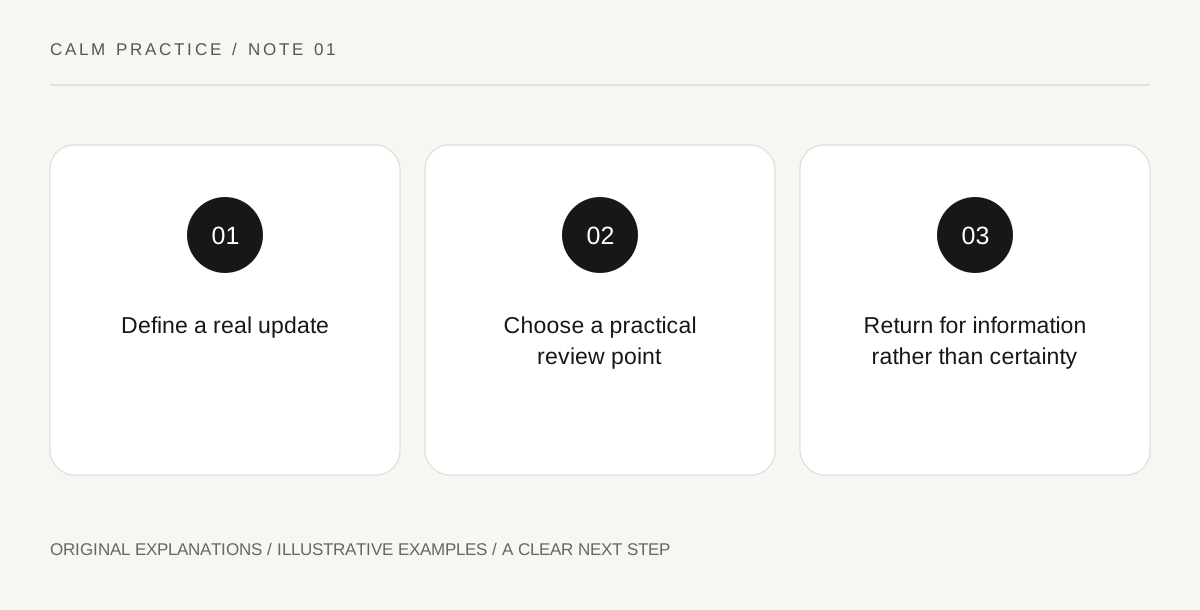
Original explanatory diagram. Read the full method and limitations below.
Identify the information that could actually change
Write the specific question and the source that can answer it. A service announcement, appointment result and another person's reply have different update routes. Ask whether new information is expected at a known time or whether the timing is unknown. NHS advice on uncertainty encourages attention to useful actions in the present. The application here is narrow: define what counts as an update rather than treating every refreshed page as new evidence. Keep genuine emergency or care instructions separate. If a service has told you to monitor a channel continuously, follow that requirement rather than substituting a generic checking schedule.
Separate checking from asking for certainty
Notice whether the latest check answered the question or simply repeated the same content. A familiar screen can feel like action without changing what you know. Do not criticize yourself for the urge; uncertainty can be uncomfortable. Instead, name the practical limit: this source has not changed and another refresh cannot force a reply. Avoid asking several people to repeat the same reassurance when none has new information. If the matter needs clarification, make one clear appropriate enquiry. The goal is an accurate information route, not proving that you can tolerate uncertainty without support.
Write the next review point in terms of an event when that is clearer than a clock time. For example, check after the service's announced briefing is different from checking whenever worry rises. If the source changes its schedule, update the plan. Keep a distinction between a new fact and another person's speculation about the same fact. That distinction helps you decide whether there is actually a new task to perform.
Choose a realistic review point
Set the next check around the source's actual update pattern or a reasonable practical need. This is an original planning choice, not a clinically established interval. Keep an urgent contact route available where necessary. Put the review point somewhere you already use, then choose an ordinary activity that can be done while waiting. It need not be especially calming or productive. Preparing food, completing a small household task or talking with someone can coexist with concern. Do not require the feeling to disappear before leaving the page; the action is closing the check, not achieving perfect reassurance.
Reopen for information, then revise the plan
At the review point, look for a genuine change and act on relevant instructions. If nothing changed, preserve that fact rather than inventing a meaning from silence. A delayed reply does not automatically establish rejection or danger. If the waiting becomes unmanageable, affects sleep or disrupts daily life, seek appropriate support. This approach is not a treatment for compulsive checking or another condition. It is a modest information-management experiment. Review whether it reduced unnecessary checking without missing responsibilities, and change it if the real situation requires a different route.
An illustrative service update
A train service says the next disruption update will appear later in the afternoon. Bea confirms that source, preserves necessary travel alerts and stops refreshing unrelated posts. She checks at the relevant point and uses the time for an ordinary meal. The concern remains, but the information task has a clearer boundary.
Practical checks
Optional checkboxes save only in this browser.
Questions that come up
Does closing the page mean I should feel calm?
No. You can still feel concerned while choosing not to repeat an uninformative check.
Should this replace clinical advice about checking behavior?
No. Follow your treatment plan and seek help when repeated checking is persistent or disruptive.
References and scope
These sources support the factual background. Examples and exercises are original illustrative teaching material. References do not imply endorsement.
- NHS: Dealing with Change and Uncertainty — Managing uncertainty and focusing on useful present actions.
- NIMH: My Mental Health, Do I Need Help? — Seeking professional help when symptoms persist, worsen or impair daily function.