Respond to a small mistake without turning it into a verdict on yourself
A missed attachment or awkward sentence can quickly become a broad conclusion that you are incompetent. A balanced response keeps the actual problem visible and leaves room to repair it. The aim is accurate thinking and proportionate action, not forcing a positive slogan or denying a real consequence.
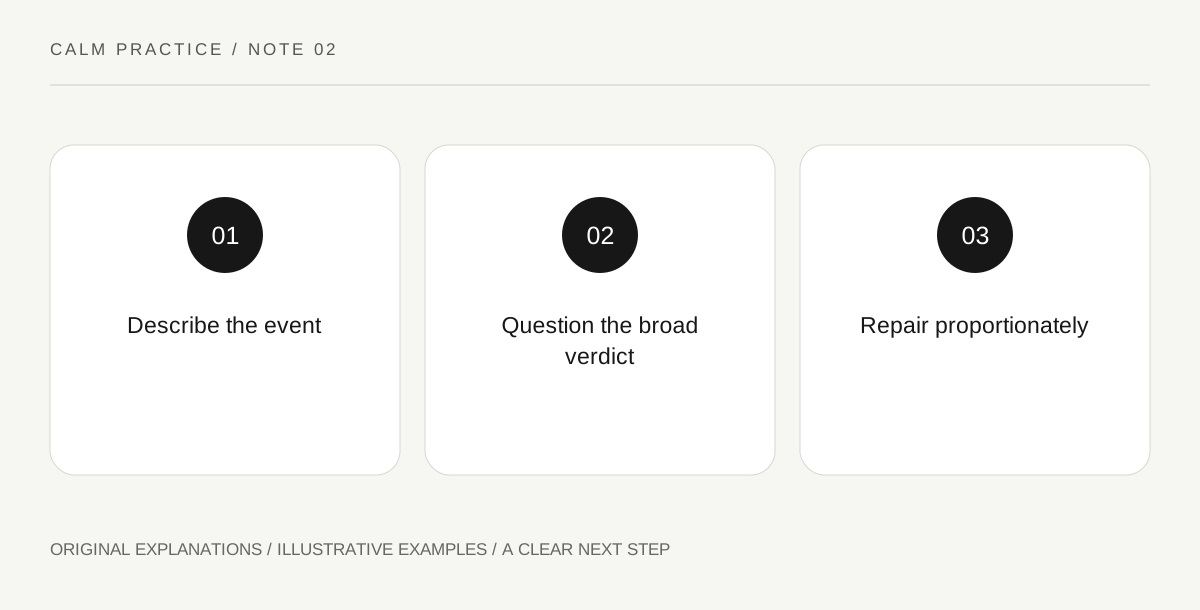
Original explanatory diagram. Read the full method and limitations below.
Describe the event in observable terms
Write what happened without adding a character judgment. Sent an email without the attachment is an event; always ruin everything is a much larger claim. NHS guidance on reframing thoughts encourages examining unhelpful interpretations. Start with one ordinary low-stakes example rather than a traumatic event or a serious issue needing professional support. Include any real consequence you know, but distinguish it from imagined reactions. You do not need to pretend the mistake was harmless. Accuracy means preserving both the omission and the fact that one omission does not describe every part of your competence.
Notice the leap from event to identity
Look for words such as always, never or everyone when they appear in the thought. Ask what evidence supports that broad statement and what information is missing. This is not an argument that you must win against your own mind. A thought can remain emotionally convincing while being too sweeping. Avoid replacing it with an equally absolute claim that you are perfect. A more useful sentence might acknowledge the mistake and your ability to send a correction. Keep the wording believable enough to use, rather than selecting the most cheerful sentence available.
Choose a repair proportionate to the problem
If a practical correction is possible, do it through the appropriate channel. A brief follow-up with the attachment may solve the actual issue; a long apology explaining your entire history may not be needed. If another person was affected, acknowledge the relevant impact without demanding immediate reassurance. Do not use reframing to avoid responsibility. The useful separation is between a repairable action and a global self-judgment. Ask for help when the issue is beyond your role or understanding. A serious work, legal or safety consequence needs the relevant process rather than only a private wellbeing exercise.
Consider what you would say to a colleague describing the same small error. The aim is not to borrow an unrealistically generous verdict but to notice whether you apply a much broader standard to yourself. You might acknowledge the omission, suggest the correction and avoid predicting a ruined career. Use that proportionate language in your own response. A fair standard can include accountability without turning one event into a permanent identity.
Let the repair end before the feeling does
After the appropriate action, return to an ordinary next task. You may still feel embarrassed. Repeatedly rereading the correction or asking whether everyone is angry can extend the event without adding useful information. Review later only if there is a concrete lesson, such as using an attachment check. Avoid turning one error into a complex prevention system for every future message. If harsh self-criticism is persistent or affects your daily life, seek qualified support. The exercise is an everyday application of balanced thinking, not a guarantee that embarrassment disappears or a replacement for therapy.
An illustrative email correction
Niko notices a missing attachment and thinks he is unreliable. He separates the actual omission from that broad judgment, sends a concise correction and adds one relevant check to his workflow. He then returns to work while still feeling a little embarrassed, without asking several colleagues to certify that everything is fine.
Practical checks
Optional checkboxes save only in this browser.
Questions that come up
Does balanced thinking excuse a mistake?
No. It can help you take responsibility for the actual event without adding an unsupported global judgment.
Must I believe a positive statement immediately?
No. Aim for accuracy and a useful next action, not forced optimism or instant emotional change.
References and scope
These sources support the factual background. Examples and exercises are original illustrative teaching material. References do not imply endorsement.
- NHS: Reframing Unhelpful Thoughts — Examining thoughts and considering balanced alternatives.