Choose one action that reflects a value when the day feels unsettled
A value can guide a small action even when your mood is uncertain. It describes a direction you care about, such as kindness, learning or reliability, rather than a target that must be completed perfectly. This approach helps make the next choice concrete without promising that meaningful action removes distress.
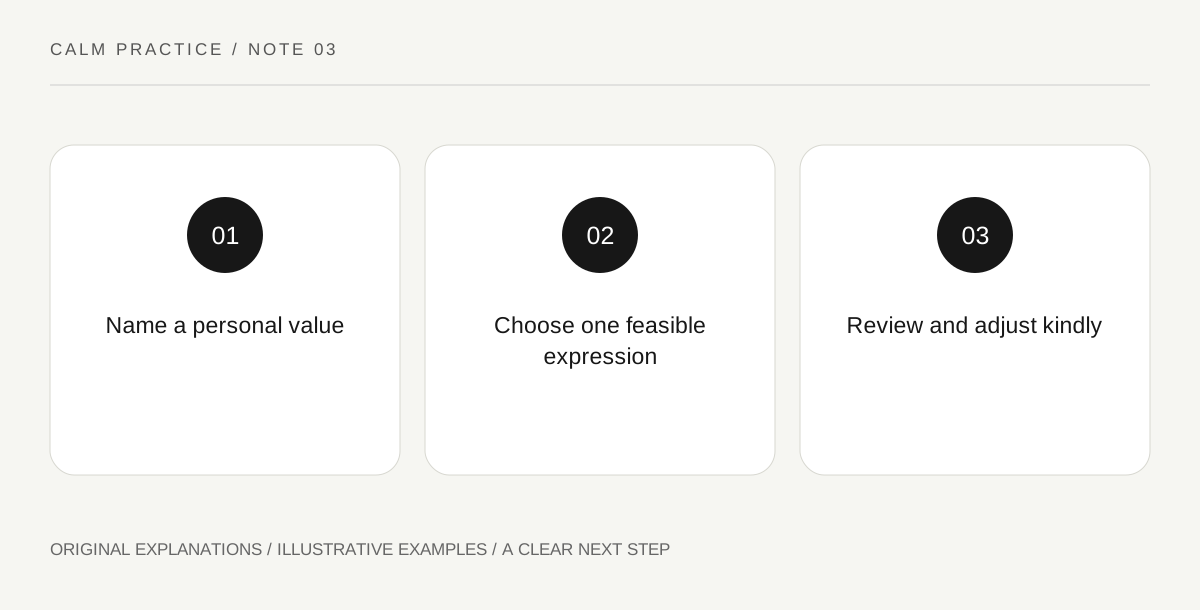
Original explanatory diagram. Read the full method and limitations below.
Describe a direction rather than an achievement
WHO's stress guide includes acting on values. A value is a quality of action you want to bring into life, not a score or a final result. Being caring differs from making every person happy; being curious differs from finishing a course today. Choose wording that feels personally meaningful rather than borrowing a list of admirable traits. You do not need to identify your entire life's purpose. Start with one ordinary situation and ask how you would like to behave within it. Keep the choice flexible enough to allow mistakes, limits and changing circumstances.
Find an action small enough for the real day
Connect the direction to something you can actually do. Reliability might mean sending an honest update about a deadline; kindness might mean listening attentively to a friend for an agreed short time. The action should fit your energy, resources and responsibilities. A value does not require overcommitting or ignoring your own needs. Avoid choosing a dramatic gesture because a small action feels insufficiently meaningful. The point is a usable direction under current conditions, not a performance for an audience. If a task needs another person's agreement, ask rather than assuming your intended kindness gives permission.
Allow difficult feelings to come along
You may feel anxious, sad or distracted while taking the action. Do not use the value as a demand to become calm first. Equally, do not force an activity that is unsafe or beyond your capacity. Choose an appropriate version and seek support when needed. A person can care about connection while deciding that a large gathering is too much today, then send a thoughtful message instead. The action is not a test of moral worth. It is one way to steer a moment without requiring every internal experience to agree with the direction.
Review the fit rather than awarding a character grade
Afterward, ask whether the action reflected the value and whether its scope was workable. If it created strain or crossed a boundary, revise the action rather than declaring the value wrong. Keep the review brief. You do not need to document every good deed or build a streak. A value can guide another choice tomorrow without turning into a productivity system. If distress persists or makes everyday functioning difficult, professional support can coexist with this practice. Values-based reflection is an optional wellbeing tool here, not a diagnosis, therapy session or guarantee of improved mood.
Keep values distinct from other people's approval. An honest update may disappoint someone while still reflecting reliability. A caring action may include saying that you cannot provide help beyond an agreed limit. If the action is chosen only to remove another person's displeasure, revisit whether it serves your own direction and responsibilities. Values can guide behavior under imperfect conditions; they do not guarantee a comfortable reaction from everyone involved.
An illustrative reliable update
Asha values reliability but cannot finish a promised task on time. She sends a clear early update and proposes a realistic next step instead of staying silent until she feels less anxious. The action reflects the value without meeting an impossible standard of never disappointing anyone.
Practical checks
Optional checkboxes save only in this browser.
Questions that come up
Must a meaningful action be large?
No. A small appropriate action can express a value within the resources and responsibilities you actually have.
Should the action remove uncomfortable feelings?
Not necessarily. The purpose is choosing a direction, not controlling every feeling. Seek support when distress is persistent or impairing.
References and scope
These sources support the factual background. Examples and exercises are original illustrative teaching material. References do not imply endorsement.
- WHO: Doing What Matters in Times of Stress — Values, unhooking from difficult thoughts, making room for feelings and kindness.