Notice a difficult thought without treating it as an instruction
A thought can be loud, repetitive or upsetting without being a command you must follow. Noticing it as a thought can create a little space for the next decision. This is an optional everyday practice, not a way to suppress thoughts or a substitute for care when experiences are distressing or unsafe.
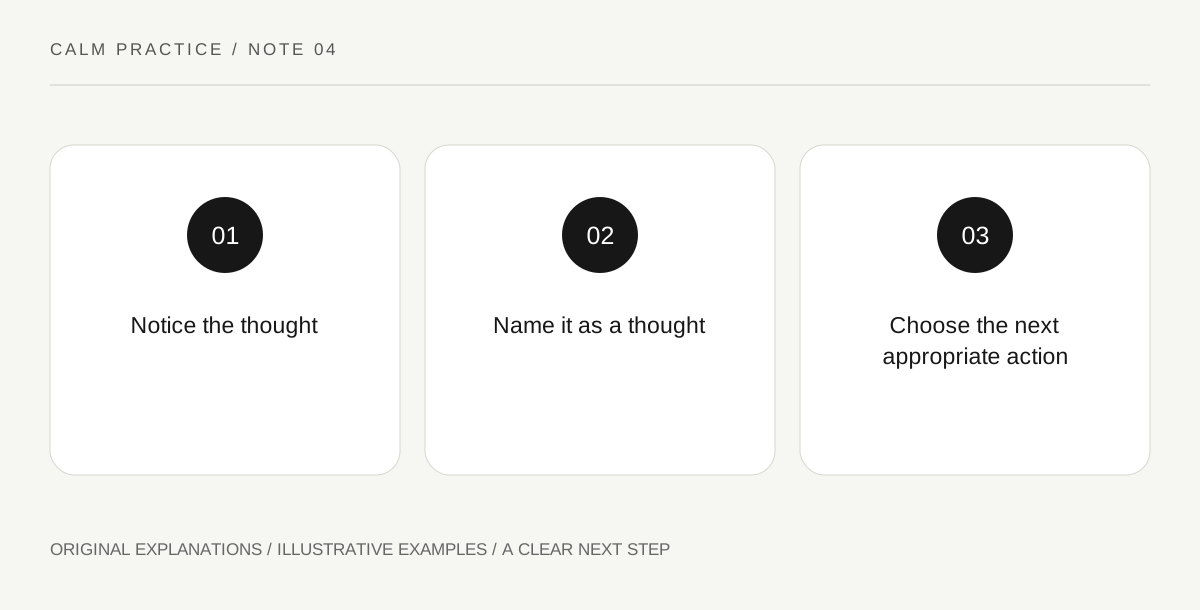
Original explanatory diagram. Read the full method and limitations below.
Use an ordinary low-stakes example
Choose a familiar thought such as I will make a fool of myself at the meeting, rather than deliberately bringing up your most distressing memory. WHO's guide includes unhooking from difficult thoughts. The application here is noticing the thought's presence without automatically making it the plan. You do not have to prove it false before taking a reasonable action. Keep the setting safe and stationary, with no driving or task requiring full attention. If the exercise intensifies distress or feels unsuitable, stop and choose another form of support. No technique needs to be endured to demonstrate commitment.
If the thought contains a practical reminder, preserve that reminder in a useful form. The sentence I will forget everything may prompt writing one meeting note, without requiring you to accept its prediction. This avoids treating every thought as either a fact to obey or meaningless noise to discard. You can extract the relevant task and leave the broad forecast unresolved. The next action then rests on the actual situation rather than the thought's intensity.
Name the thought in simple language
You might say privately, I notice the thought that this will go badly. That wording describes an internal event rather than a settled fact. It is not a magic phrase, and repeating it many times is not required. Avoid mocking yourself or treating the thought as stupid. A concern may contain a practical issue worth addressing even when its conclusion is sweeping. The useful distinction is between noticing the sentence and obeying it automatically. If you prefer ordinary words, use them; the practice does not depend on adopting a technical vocabulary or performing a particular voice.
Return attention to the choice in front of you
Ask what appropriate action is available now. For a meeting, it might be opening the agenda or writing one question. For a social invitation, it might be deciding whether the event fits your needs. The thought can remain present while you make that choice. Do not use the exercise to ignore a genuine danger, a boundary violation or professional advice. If the concern points to something practical, handle that through the relevant route. Noticing a thought is not a rule that every worry is irrational or that all hesitation should be overcome.
Keep the result modest and reviewable
After trying the practice, ask whether it gave you a useful pause before action. You do not need a quiet mind or a lower mood score to count the attempt as informative. If it becomes another repeated reassurance ritual or makes you feel more detached or distressed, stop and seek appropriate guidance. Persistent intrusive or frightening experiences deserve professional support rather than endless self-help experimentation. The everyday aim is a more deliberate next choice, with room for uncertainty. A thought's intensity does not by itself determine the truth of its prediction or the action you must take.
An illustrative meeting thought
Before a routine meeting, Eli thinks he will say something foolish. He notices that prediction, checks the agenda and prepares one relevant question. He does not argue with the thought for half an hour or require it to disappear before attending. If the practice were distressing, he would stop and use another support option.
Practical checks
Optional checkboxes save only in this browser.
Questions that come up
Am I supposed to stop the thought?
No. The aim is noticing it without automatically following it, not forcing it out of awareness.
Does this mean ignoring real risks?
No. Practical dangers, boundaries and professional advice still matter. Use the relevant information to make the decision.
References and scope
These sources support the factual background. Examples and exercises are original illustrative teaching material. References do not imply endorsement.
- WHO: Doing What Matters in Times of Stress — Values, unhooking from difficult thoughts, making room for feelings and kindness.