Give a slow queue a practical decision instead of an endless argument in your head
A slow line can create frustration because the next few minutes feel outside your control. A useful response identifies the decision you still have: wait, ask, choose an alternative or leave. This is an ordinary planning tool, not a demand to enjoy delays or tolerate unsafe conditions.
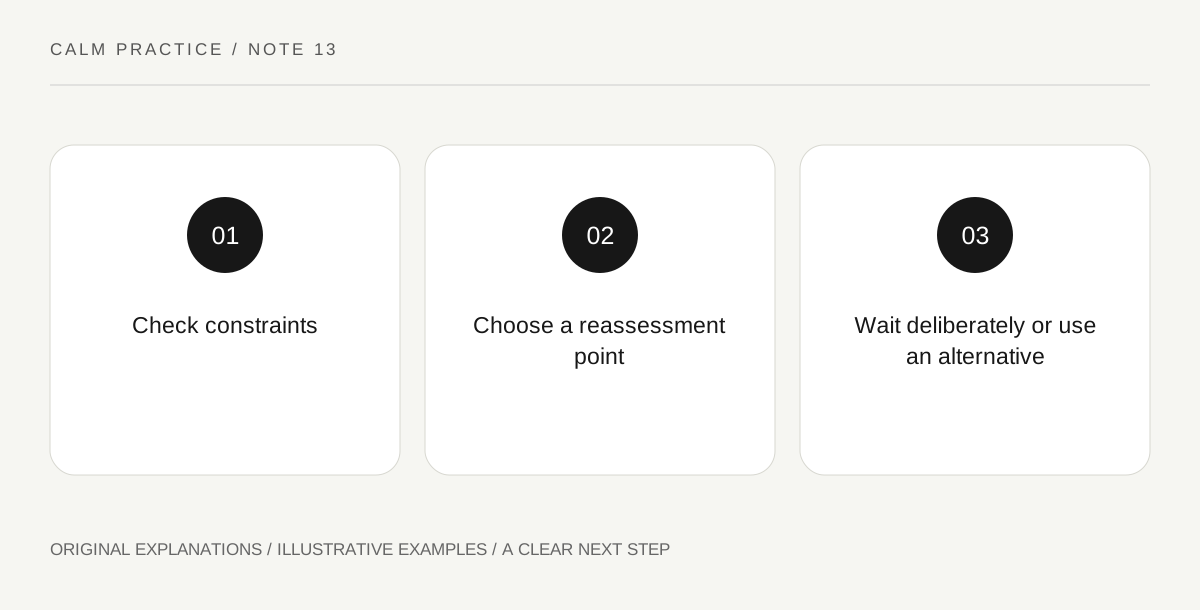
Original explanatory diagram. Read the full method and limitations below.
Check the real constraint
Look for official information about the queue, closing time, access arrangements and whether another route is available. Avoid assuming that the person at the front controls the delay. If you have a time-sensitive need, ask staff clearly and respectfully. NHS problem-solving guidance distinguishes actionable problems from matters outside immediate control. The application here is a small service delay. A genuine medical emergency, unsafe crowd or accessibility problem needs an appropriate response rather than a patience exercise. Keep exits and required supervision in view, and do not become so absorbed in a phone that you lose awareness of the setting.
Name the available choice
Ask what would change your decision: an estimated wait, a missed connection, discomfort or another practical limit. You may choose to stay even while annoyed. You may also decide that leaving is appropriate. A decision does not require pretending the service is good or that the delay is fair. Keep the criteria concrete enough to use. Instead of repeating this is taking forever, identify the next point at which you will reassess. This is an illustrative planning boundary, not a scientifically established number of minutes or a rule that everyone must tolerate the same wait.
Consider comfort needs that affect waiting, such as accessible seating, a toilet or the ability to stand safely. Asking for an appropriate accommodation is different from demanding that a queue disappear. The relevant service can explain what is available. A patience strategy should never be used to shame someone for a disability, pain or another access need. The practical decision includes those needs alongside time and service information.
Use attention for something compatible with waiting
Choose an activity that preserves your place, awareness and ability to hear instructions. Reading a short passage, noticing the surroundings without intense analysis or having a quiet conversation may fit. Avoid turning the pause into a competition to be perfectly mindful. If the queue moves, put the activity away safely. Do not use a breathing or eyes-closed practice while navigating a crowded line. The goal is a manageable waiting experience, not erasing all irritation. A neutral activity can coexist with frustration and reduce the time spent rehearsing arguments that do not change the service.
Act at the review point and close the loop
When the relevant information or time boundary arrives, make the practical choice. Ask for an update, use an alternative or continue waiting deliberately. If feedback or a complaint is appropriate, use the official route later with facts rather than escalating at an uninvolved worker. Keep anger that becomes harmful or repeatedly disrupts life as a reason to seek qualified support. The useful outcome may be simply leaving at a sensible point or completing the errand without an avoidable confrontation. It does not require a pleasant mood or agreement that the delay was acceptable.
An illustrative service line
Harper joins a queue before another appointment. She asks about the expected wait and decides when she would need to leave. While waiting she reads something short and keeps announcements audible. At her chosen practical boundary she uses an alternative route rather than remaining in line while repeatedly arguing with the delay internally.
Practical checks
Optional checkboxes save only in this browser.
Questions that come up
Must I stay to practice patience?
No. Leaving or choosing an alternative may be the appropriate practical decision.
Should I close my eyes for a relaxation exercise in a moving queue?
No. Preserve environmental awareness and safety. Choose an activity compatible with the setting.
References and scope
These sources support the factual background. Examples and exercises are original illustrative teaching material. References do not imply endorsement.
- NHS: Problem Solving — Distinguishing an actionable problem from a hypothetical worry and reviewing a chosen action.
- NHS: Anger — Taking time before reacting and seeking help for persistent or harmful anger.