Examine the rule that says rest must be earned by finishing everything
A free moment can feel uncomfortable when an internal rule says every task must be complete before rest is allowed. The rule may be impossible to satisfy in ordinary life. A balanced review distinguishes real responsibilities from an unlimited condition, without pretending that a personal pause can solve workload or care arrangements on its own.
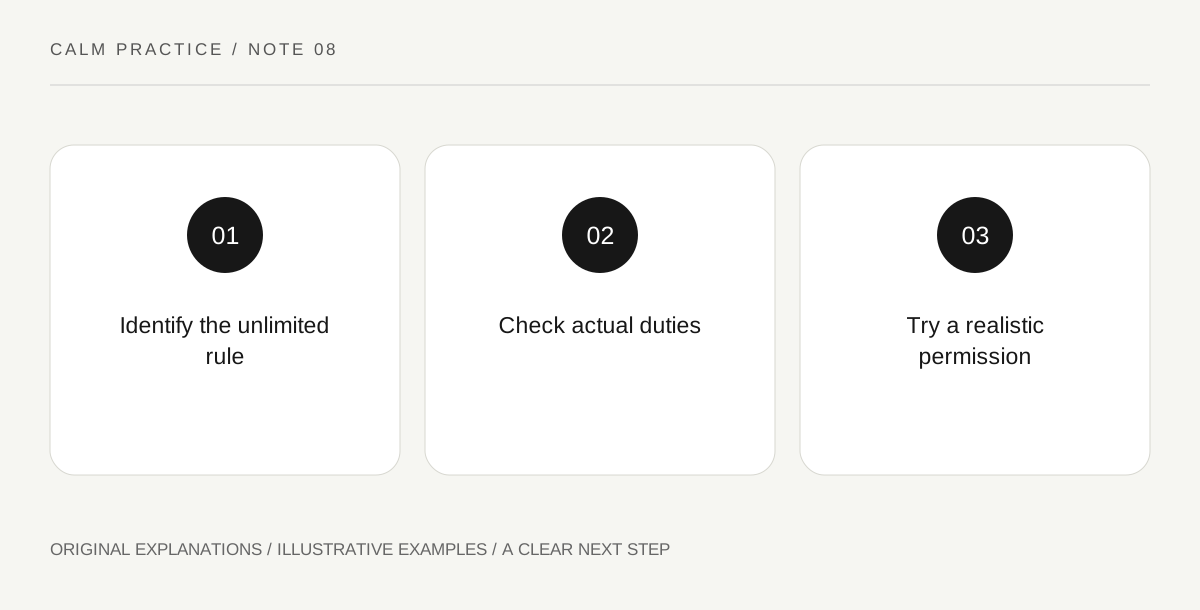
Original explanatory diagram. Read the full method and limitations below.
Write the rule in its actual words
Notice whether the thought says you should finish one important task or everything. The difference matters. NHS reframing guidance encourages examining broad or unhelpful conclusions. A rule with no endpoint can make rest permanently unavailable. Write it as a statement rather than treating it as an unquestionable fact. You do not need to argue that all work is optional. Some duties are real and time-sensitive. The practical question is whether the rule accurately describes those duties or adds an unlimited demand that no ordinary household or worker could reliably meet.
Check whether rest has been defined too narrowly. A person might prefer quiet company or a familiar low-demand activity to sitting alone. The pause does not have to resemble a wellness photograph. Choose what fits the available setting and your needs, while keeping necessary responsibilities covered. An ordinary welcome activity can be enough; it does not need to be optimized, documented or defended through a promise of better performance afterward.
Check the real responsibility and consequence
Identify what genuinely needs attention now, who is responsible and whether coverage or a handover is required. A person providing continuous care cannot simply leave a duty unattended, and a safety-critical task needs its proper process. Once those needs are addressed, ask whether another optional task is being promoted into a condition for resting. Keep external workload problems visible. If the amount of work is persistently unmanageable, a conversation about scope, staffing or support may be needed. A private thought exercise should not make an impossible system seem like a personal failure to relax efficiently.
Try a believable alternative rule
A useful alternative might be that necessary responsibilities are covered and a pause can occur before every optional task is complete. Choose wording you can honestly use. Avoid replacing guilt with a command that you must enjoy rest immediately. You may feel uneasy at first. Select a suitable ordinary pause that fits the available time, without making it another achievement project. It can be quiet or social, active or still, depending on preference and circumstances. The point is permission based on a realistic assessment, not a reward granted only after a flawless performance.
Review whether the rule helped or hid a problem
Afterward, ask whether the responsibility was covered and whether the pause was feasible. If guilt remains intense or a broader pattern affects wellbeing, seek support. If the practical arrangement failed, fix that issue rather than concluding rest is inherently irresponsible. Avoid measuring the pause only by productivity afterward. Rest need not pay for itself through faster work to be legitimate. This is an everyday reflection on a thought pattern, not a treatment or a guarantee of calm. Its useful result is a more accurate rule that leaves room for needs, duties and human limits.
An illustrative unfinished kitchen
Tomas has completed necessary evening care and left the kitchen safe, but believes he must reorganize a cupboard before sitting down. He identifies that extra condition as optional and takes a suitable pause. He still feels some guilt, yet does not treat the feeling as proof that another chore is required.
Practical checks
Optional checkboxes save only in this browser.
Questions that come up
Does rest require abandoning duties?
No. Arrange essential care and safety responsibilities appropriately. The question concerns unlimited added conditions, not ignoring real obligations.
Must the pause make me more productive?
No. That need not be the only justification. Review whether the arrangement fits your needs and responsibilities rather than demanding a measurable return.
References and scope
These sources support the factual background. Examples and exercises are original illustrative teaching material. References do not imply endorsement.
- NHS: Reframing Unhelpful Thoughts — Examining thoughts and considering balanced alternatives.
- NIMH: Caring for Your Mental Health — Self-care, regular nourishment, enjoyable activities and professional support.