Let an uncomfortable feeling be present without making it the whole day's task
A disappointing message can leave a feeling that does not resolve on schedule. It may be possible to acknowledge that feeling while continuing an ordinary part of the day. This does not mean approving what happened, forcing acceptance of harm or avoiding support; it means leaving space for experience without demanding an immediate emotional fix.
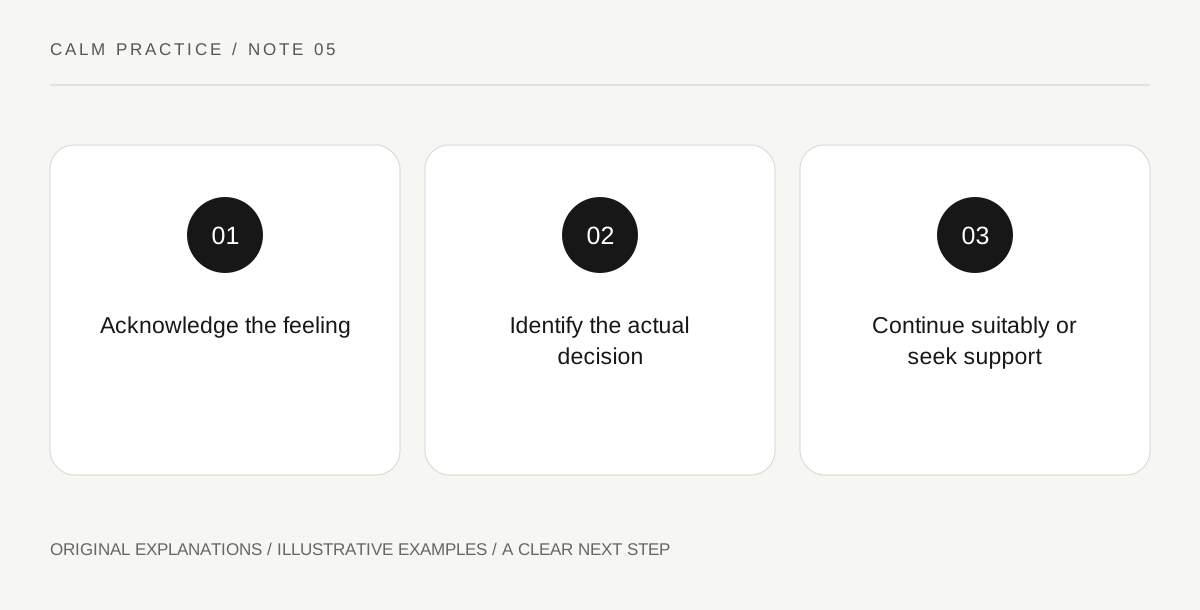
Original explanatory diagram. Read the full method and limitations below.
Name what you notice without a diagnosis
Use ordinary words such as disappointed, tense or sad if they fit. You do not need to choose the perfect label or explain every cause. WHO's stress guide includes making room for emotions. Start with a manageable everyday feeling rather than deliberately revisiting trauma or overwhelming distress. If the exercise feels unsafe or intensifies the experience, stop. A brief acknowledgement can be enough: this is difficult right now. Avoid turning the moment into an assessment of whether you are reacting correctly. Feelings can vary across people and situations without needing a competition over who has the stronger justification.
Separate the feeling from the external decision
Acknowledge the emotion while still asking what the situation requires. A disappointment may need a conversation, a practical change or no immediate action. Making room for a feeling does not mean accepting mistreatment or staying in an unsafe setting. Boundaries and appropriate help remain important. Likewise, feeling upset does not automatically mean an urgent message must be sent. Give the external decision its own information and timing. This separation can keep the day from becoming a single project of either suppressing the emotion or acting on it immediately to make it go away.
Consider whether the ordinary activity needs a smaller version today. Cooking a simple meal may be appropriate when a complicated recipe is not, and a brief contact may fit better than a large gathering. Adapting the task is different from making the feeling disappear. It leaves room for the day to continue at a workable scale. Avoid turning that adaptation into a permanent conclusion about what you can or cannot do in the future.
Choose an ordinary activity that can coexist
Pick something suitable and manageable, such as eating a meal, doing a familiar task or spending time with a supportive person. It does not need to distract you completely. The feeling may return to attention, and you can acknowledge it again without starting the entire exercise over. Keep essential responsibilities and safety in view. Do not use a demanding activity to prove resilience or avoid sleep, food and care. An appropriate routine can provide structure while the emotion changes at its own pace. It is not a guarantee that staying busy will make every feeling fade.
Notice when support is the next appropriate action
If distress persists, worsens or interferes with daily life, ask a qualified professional for support. You do not need to demonstrate that you accepted the feeling successfully before seeking help. Talk with trusted people in a way that respects their capacity and your privacy. Review whether the practice was useful or whether another approach fits better. The aim is flexibility, not a new rule that emotions should always be observed quietly. Some situations call for action, protection or treatment. This everyday reflection should make room for those responses rather than replacing them with a demand to remain calm.
An illustrative disappointing reply
Mira receives a disappointing but nonurgent reply. She names the sadness, decides that no response is needed immediately and eats the meal she had planned. The feeling remains part of the evening without becoming a requirement to keep analyzing the message. Later she decides whether a practical conversation would help.
Practical checks
Optional checkboxes save only in this browser.
Questions that come up
Does allowing a feeling mean agreeing with what happened?
No. You can acknowledge an emotion while maintaining boundaries or taking appropriate action.
Must I manage alone before asking for help?
No. Support can be appropriate at any point, especially when distress is persistent, worsening or disruptive.
References and scope
These sources support the factual background. Examples and exercises are original illustrative teaching material. References do not imply endorsement.
- WHO: Doing What Matters in Times of Stress — Values, unhooking from difficult thoughts, making room for feelings and kindness.
- NIMH: My Mental Health, Do I Need Help? — Seeking professional help when symptoms persist, worsen or impair daily function.